
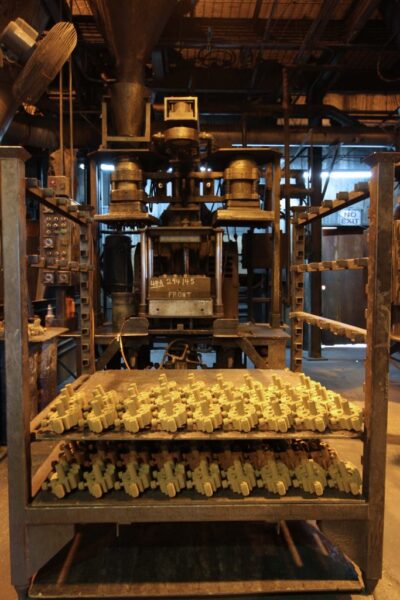
Producing gray iron castings with complex internal geometry requires much more than just excellent melting and molding processes. When your product design necessitates intricate internal cavities, deep cores, thin webs, cooling passages, or other hard-to-reach features, precision-based core making becomes just as important as the molding and casting itself.
What separates a foundry that merely can make “cored” parts from one that makes them reliably, precisely, and cost-effectively is how well its core room is designed and integrated into the rest of the foundry process.
That’s why Acme Foundry’s in-house core room is a key competitive advantage. It enables us to deliver complex, intricately cored gray iron castings that meet tight tolerances while reducing turnaround time and delivering more value to our customers.
Reliably Achieving Complex Casting Features with Core Room Integration
The cores produced in Acme’s integrated core room are formed with precision and then inserted into molds to create internal cavities, holes, passages, or undercuts that would otherwise be impossible to cast with mold sand alone. In other words, we can tackle complex casting designs without relying on third-party core makers or pattern shops.
Foundries with an integrated core room like Acme can also offer substantially quicker turnaround times since we don’t have to send core work out or coordinate rework with third parties. By keeping the process in-house, we keep your project lean, responsive, and quality-focused.
Meeting Your Custom Cored Casting Designs
Precision Internal Features: Our custom cores allow for voids, internal shapes, and thin cross-sections that are critical to functionality.
Better Repeatability and Tolerance Control: Keeping core making, melting, molding, and casting processes closely coordinated improves consistency, quality, and efficiency.
Faster Turnaround: Our in-house core room eliminates delays from subcontractors and improves coordination across design, tooling, core production, molding, and final casting.
Greater Design Flexibility: Design engineers can propose more ambitious internal geometries knowing the foundry has the capability to support them.
Better Cost Control: By handling core making internally, we control materials, processes, scrap, rework, and setup—working closely with customers to keep projects on budget.
From Design to Finished Casting: An Inside Look at Acme Foundry’s Workflow
To give you a clear picture of how Acme takes your product from concept through the core room to the final casting, here’s an overview of our manufacturing process:
Design / Quotation Stage
- Customers provide drawings, 3D models, tolerances, and any special requirements such as internal passages, cooling channels, metallurgical specifications, or surface finish constraints.
- We review designs for castability, identifying areas that may require special core work, support, feeding, or risering, and suggest design optimizations when necessary.
- We prepare detailed cost estimates covering tooling, core work, materials, machining, and finishing.
Tooling, Pattern, and Core Design
- Patterns are built in-house if not provided by the customer. Tooling is designed or modified to accommodate complex cores, including core prints, supports, and mold recesses.
- We engineer cores to create internal geometry, selecting appropriate sand types, binder systems, strength requirements, core supports, assemblies, and curing schedules.
Core Room Operation
- Core manufacturing includes sand mixing, binder addition, forming cores in core boxes, and curing under controlled conditions.
- Cores undergo detailed inspections to verify dimensions, integrity, and surface quality, ensuring no cracks, warpage, or defects.
- Cores are staged and stored carefully prior to molding to prevent damage or distortion.
Molding, Melting, and Pouring
- While cores are produced, molds are prepared and cores are inserted according to specifications.
- Gray iron is melted, prepared, and poured, with molds designed to accommodate core alignment, weight, and thermal stresses.
- Proper gating, risering, and cooling control are critical, as cores introduce additional thermal complexity.
Shakeout, Internal Clean-Up, and Finishing
- After solidification, castings are shaken out and cores are removed to reveal internal geometry. Residual sand or binder is cleaned through blasting, brushing, or chemical methods as required.
- Final machining is performed when needed through Acme’s integrated Magic Circle CNC Machining division to achieve tight tolerances, smooth surface finishes, and precise features.
Quality Control and Final Inspection
- Castings are inspected throughout production and at completion for dimensional accuracy, internal defects, material properties, and surface finish as part of Acme’s comprehensive quality control system.
- Any issues related to core performance—such as shift, breakage, or sand inclusion—are traced back to root causes and corrected quickly to keep projects on track.
Ready to take advantage of Acme’s end-to-end core making and custom casting solutions? Get in touch to discuss your products or start your next project.