
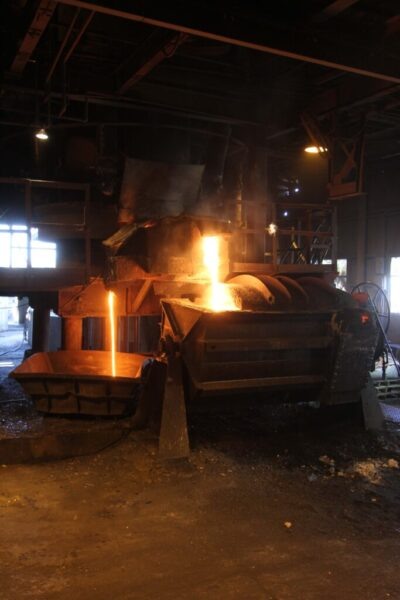
Gray iron looks simple on a drawing. In the melt, it is a carefully balanced iron-carbon-silicon alloy whose flake graphite decides how a part fills, machines, damps vibration, and carries load.
Acme Foundry has manufactured gray iron castings since 1905. More than technical expertise in materials science, we bring 120+ years of real-world foundry practice to every project. But when you’re manufacturing the huge range of complex cast products that we work with, you need to understand the science of the material as well as how it behaves in the mold, how it responds to machining…not to mention how it will perform in the end application.
On that note, we put together a series of gray iron material charts, describing how chemistry, class, and material properties fit together. We hope they’re of value for developing or understanding your products.
Reach out to the Acme team anytime about specific product development questions you may have, or if you’re still unsure whether or not gray iron is the material for the job.
How Is Gray Iron Created?
Gray iron contains more carbon than austenite can dissolve. The excess carbon solidifies as flake graphite in a ferritic, pearlitic, or mixed matrix. Those flakes create the gray fracture, excellent machinability, high damping, and strong thermal conductivity. They also cut tensile ductility to essentially zero, so this is not a shock-loaded, high-elongation metal.
Typical commercial iron runs about 2.5 to 4% carbon and 1 to 3% silicon. Carbon equivalent is the melt-deck shorthand for graphitization, fluidity, and chill. If you’re mathematically inclined, here’s the equation to know:
- CE = %C + (%Si / 3) + (%P / 3)
Basically, higher CE fills better and damps more. Lower CE raises strength and modulus, with more section sensitivity. Manganese should balance sulfur so MnS forms instead of grain-boundary FeS: %Mn = 1.7 x (%S) + 0.15.
Typical Chemical Composition of Gray Iron
ASTM A48 specifies tensile class, not a single chemistry. We still work inside well-known ranges and then tune carbon, silicon, and alloys for thickness and microstructure.
| Element | Typical range | Role |
| Carbon | 2.5 to 4.0% (often 3.0 to 3.5%) | Flake graphite, fluidity, damping, machinability |
| Silicon | 1.0 to 3.0% (often 1.8 to 2.4%) | Graphite instead of carbide; better castability |
| Manganese | 0.4 to 1.2% | Ties up sulfur; higher levels support pearlite |
| Sulfur | 0.05 to 0.12% typical | Small amounts aid nucleation; excess is harmful without Mn |
| Phosphorus | 0.02 to 0.10% typical | Fluidity; too much increases brittleness |
| Iron | Balance | Load-bearing matrix |
Physical and Mechanical Properties of Gray Iron
Gray iron is often the best material when vibration control, heat movement, complex geometry, and machining cost matter more than tensile elongation. Compressive strength is typically three to four times tensile strength, and graphite flakes act as chip breakers and thermal paths.
As always with manufacturing materials, there are tradeoffs: very low ductility, low impact toughness, and a risk of chill in thin or fast-cooling sections. Higher classes gain strength and wear resistance. However, in turn, the materials lose some damping, thermal-shock resistance, and thin-section forgiveness.
| Property | Typical values | Shop-floor meaning |
| Density | About 0.26 lb/in3 (7.1 to 7.3 g/cm3) | Slightly below carbon steel |
| Melting range | About 2050 to 2120 F | Fluid when superheat and CE match the part |
| Tensile strength | 20 to 55 ksi by class | Acme pours through Class 55, including alloyed grades |
| Compressive strength | About 3 to 4 times tensile | Strong in bases, housings, and compression features |
| Hardness | About 160 to 270 BHN | Rises with class and pearlite |
| Thermal conductivity | High versus steel | Graphite network moves heat |
| Damping capacity | Excellent | A primary reason to specify gray iron |
| Elongation | Essentially 0% | Design out sharp stress risers |
| Modulus | Lower than steel; rises with class | More compliant; section sensitive |
ASTM A48 Classes at a Glance
The class number is minimum tensile strength in ksi on a standard test bar. Lower classes run higher carbon and more graphite. Higher classes run leaner, more pearlitic, and often alloyed.
| ASTM Class | Min. tensile (psi) | Carbon composition | Typical BHN | Typical product applications |
| 20 | 20,000 | Highest C, most graphite | 140 to 190 | Thin walls, max damping, easy machining |
| 30 | 30,000 | Mid carbon | 170 to 220 | Pumps, valves, general housings |
| 40 | 40,000 | Leaner, more pearlite | 190 to 250 | Higher load and wear |
| 50 | 50,000 | Lean, often alloyed | 200 to 270 | Heavier, more demanding sections |
| 55 | 55,000 | Lean, typically alloyed | 210 to 277 | High-strength gray iron when nodules are not required |
Alloying Elements That Change the Matrix
Base Fe-C-Si chemistry sets graphite potential. Small additions tune matrix, strength, and wear when a plain class will not hold properties through thick and thin sections.
| Element | Intent | Caution |
| Nickel | Matrix strength; some graphitization help | Cost; keep the melt balanced |
| Copper | Pearlite, strength, hardness | Too much can hurt machining |
| Tin | Strong pearlite stabilizer in tiny amounts | Overdose is not useful |
| Chromium | Wear, carbides, hot strength | Excess causes chill and hard spots |
| Molybdenum | Strength at temperature | Common in higher classes with other alloys |
Gray Iron Versus Other Cast Metals
If you are still choosing among alloys, start here. Then confirm with shock, pressure, wall thickness, and machining.
| Property | Gray iron | Ductile iron | Cast steel |
| Damping | Excellent | Good | Fair |
| Machinability | Excellent | Very good | Fair to good |
| Complex / thin castability | Excellent | Good | More difficult |
| Ductility / impact | Very low | Much better | Best of the three |
| Thermal conductivity | Excellent | Good | Lower |
| Typical cost for housings | Often lowest | Higher | Highest |
| Usual sweet spot | Bases, pumps, valves, gearboxes, engine and fluid-power parts | Shock, pressure, higher tensile | Weldability or steel-like toughness |
Casting Experience Is What Matters Most
Data sheets describe what gray iron can be. The foundry determines what it will be in your walls, cores, and machining plan. Carbon equivalent, graphite, matrix, and inoculation only create value when they are tied to real cooling rates and real production practice.
Acme Foundry delivers both the material science and more than a century of hands-on gray iron experience. That is how we help customers develop products that are uniquely optimized for quality, performance, and manufacturability.