
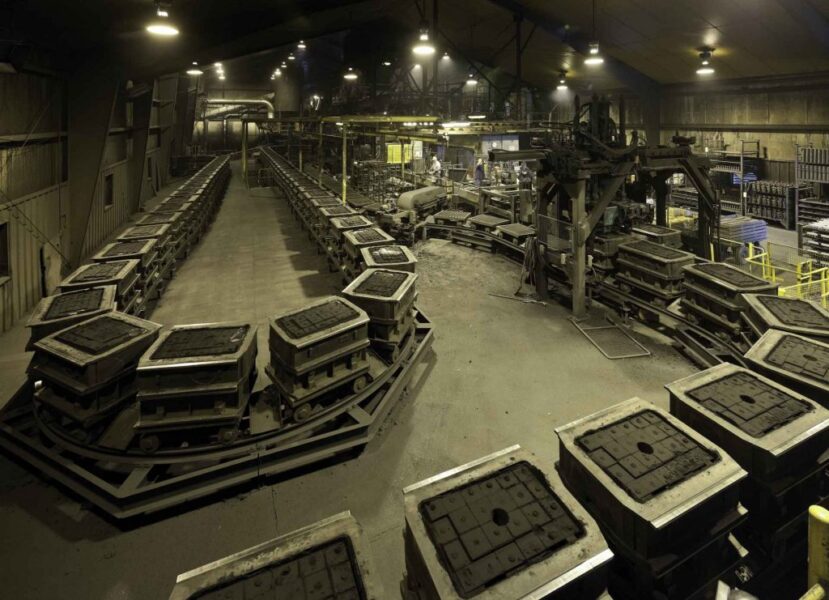
Ever wonder what actually happens between “raw iron” and a finished gray iron casting? At Acme Foundry, we’ve been refining this process for decades…actually, we’ve been at it for more than 120 years. With everything carefully orchestrated in our facility, each step flows seamlessly into the next.
On that note, we put together a virtual tour through our foundry. Read on to take a walk through our process, from the core room all the way to internal cleaning.
Your Products Start to Take Shape in the Core Room
Before a single pound of iron gets melted, we’re already building the internal geometry of your part. Cores are sand shapes that create hollow cavities, passages, and undercuts inside the finished casting. Without them, you’d have a solid chunk of metal instead of a functional component.
We make our cores in-house using a cold box process, which bonds sand with a chemical binder system and cures it quickly with a gas catalyst. The result is a strong, dimensionally accurate core that holds up to the heat and pressure of molten iron. Complex parts often require multiple cores that fit together precisely, so our core room team pays close attention to tolerances and assembly. This is where a lot of the real engineering happens, long before the furnace fires up.
Green Sand Molding: What It Is, How It Works
With the cores ready, we move to molding. Acme Foundry uses green sand molding for our gray iron work. Green sand is a mixture of silica sand, clay, water, and additives. It’s actually called “green” not because of its color or because of sustainability, but because the sand contains moisture when we put it to use. It’s just like the term “green wood” for freshly cut lumber that is still moisture-rich.
Our automated molding lines press green sand around a pattern to create the two halves of the mold, called the cope (top) and the drag (bottom). The pattern is essentially a precise replica of the part’s outer shape. Once both halves are formed, the cores get set into the drag, the cope gets placed on top, then the mold is closed and ready for iron.
Green sand molding is efficient and economical, so it’s most efficient for medium to high production volumes. The sand is also recyclable, so we recondition and reuse it throughout the day, reducing waste while keeping your costs in check.
Pouring Molten Iron
Now comes the part that looks most dramatic from the outside. Our cupola or induction furnaces melt iron to temperatures around 2,600 to 2,800 degrees Fahrenheit. We carefully control the chemistry of the melt, adjusting carbon, silicon, and other elements to hit the mechanical properties your application requires.
The molten iron gets poured into the closed molds through a gating system, which is a series of channels designed to fill the cavity evenly and minimize turbulence. A clean, controlled pour is critical. Too fast and you risk defects. Too slow and the iron can start solidifying before the mold is full. Our pour team has a practiced rhythm built from years of experience.
Cooling and Solidification
Once the mold is filled, we let physics do the work. The iron begins solidifying almost immediately, and the mold stays on the floor or conveyor while the casting cools to a safe handling temperature. Cooling time depends on the mass and wall thickness of the part. Thin sections cool fast. Heavy sections take longer.
Rushing this step creates problems, including warping, internal stress, and dimensional issues. We let each casting cool at the right pace for its geometry.
Shakeout: Separating Casting from Sand
When the casting has cooled enough, it moves to shakeout. This is exactly what it sounds like. The mold gets broken apart on a vibrating shakeout deck, separating the sand from the casting. The green sand falls through grates to be reclaimed and reconditioned, while the raw casting moves forward.
At this point, the casting looks rough. There are gates and risers attached, and the surface is covered in sand and scale. That’s completely normal. The real cleanup starts now.
Internal Cleaning and Finishing
Cores leave behind sand inside the casting’s internal passages, and that sand has to come out completely. We use shot blast equipment and vibrating equipment to break loose and remove internal sand. For complex cored castings, this step requires thoroughness and attention because any residual sand left inside can cause serious problems down the line in a customer’s assembly or machining operation.
Gates and risers get removed, and the casting goes through additional shot blasting to clean the exterior surface. From there, parts move to inspection and any required secondary operations.
The Acme Foundry Difference
Every step in the green sand casting process connects to the next. Good cores lead to good internal geometry. Good molding leads to dimensional accuracy. Good pouring and cooling lead to sound metallurgy. And thorough cleaning leads to a part you can actually use.
That’s why Acme carefully controls the process in-house. With our integrated CNC machining division, we can even tackle the next step of custom-machined castings. Our experts are standing by to help you streamline your project while providing a single source for superior quality and accountability.